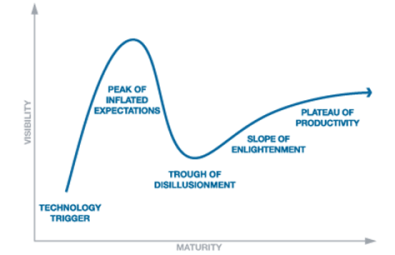
The hype-cycle is one view of technological development
Hydrogen has been popping its head up recently through various reports and is being touted as a potential option for decarbonising heat. I have previously written about hydrogen when I was considering a report from the hydrogen supergen hub last year.
I am concerned that hydrogen is becoming a momentous idea in energy (heat) policy but with limited scrutiny of the real issues. It is also being promoted in general (perhaps primarily) by the existing gas industry. As a result, the focus is moving away from other low-carbon heating sources despite the fact that these technologies i.e heat pumps, district heating, solar thermal are proven around the world. That is not to say these renewable heat solutions are cheap or easy, but they do work.
My previous blog considered issues of the cost of hydrogen appliances (high), the capacity of the network to take a lower calorific value gas (questionable) and the quite fundamental issue of how the hydrogen has been produced (unknown).
The issue of gas safety and the possibility of explosions has also been a concern for the use of hydrogen. Last year, the HyHouse project which was investigating the explosion risk of hydrogen leaks inside a house concluded. It suggested that ‘when leaks occur, the risks associated with hydrogen are comparable to those associated with a leak from natural gas (at the conditions observed at Glenglass Cottage)’ [2]. This project measured the dispersion and build-up of hydrogen within a remote Scottish farmhouse (empty at the time of testing thankfully). Basically the project showed that within this particular leaky single glazed farmhouse, the build of up hydrogen in the case of a leak would have similar risks to a leak of natural gas. As the first study of its kind it produced an interesting albeit limited conclusion to an important question around the explosion risk of hydrogen. This project clearly doesn’t prove hydrogen is safe but has generated some useful data.
On Monday this week, an Ofgem/consumer funded project led by Northern Gas Networks (a GDN) released its 400 page findings to a Westminster audience (Leeds H21 Citygate). The project investigated the prospect of converting the whole of the Leeds gas system to hydrogen, producing the gas via steam methane reformation, capturing and storing the CO2 from the process, injecting the hydrogen into the grid and converting all appliances in Leeds to run on it.
This primarily desk based study, led by a gas network and involving another gas network and consultants with known interests in hydrogen explained that it would be possible ’to decarbonise parts of the existing gas network at minimal additional cost to consumers’ using hydrogen. Did someone mention vested interests or something about Turkeys?
Looking more specifically at the detail paints an interesting and more complex picture than the executive summary would have you believe around, cost, carbon and security, the fundamental energy issues.
Firstly on cost, the study suggests that the capex for the conversion would be £2,054 million with ongoing opex of £139 million. Despite the claim that the project is cost effective, that equates to around £7800 per connection (household or business) of capex plus £525 extra per year per connection of operational costs. This is in reality a very large cost to consumers. The solution in the report is to socialise this cost across all gas consumers through distribution charges resulting in an increase of 7.2% for distribution charges in the RIIO GD2 period. Whilst I appreciate this is a test project, that is a lot of money and just because it’s smeared across consumers doesn’t make it cheap.
On the carbon point, the report suggests that the gas will effectively be decarbonised. However, whilst the project suggests reductions in carbon, these are not an elimination of carbon, something which is generally seen as a requirement for the heating sector in order to allow emissions from other sectors. The table below shows the percentage reduction compared to business as usual and the important number is 59% reduction. This is the full life-cycle based (real world) emission reduction for the project and while still significant doesn’t get near the zero carbon aspiration. The graph below shows where these emissions come from.
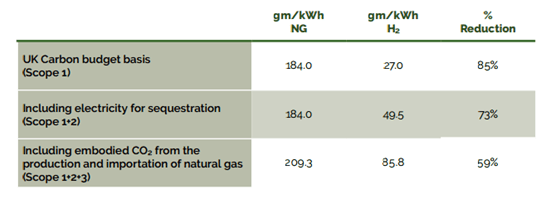

(p5 and p223 respectively)
The final point is on energy security and import dependence. The UK is currently a net gas importer. This is likely to continue and the country is expected to become increasingly dependent on imports. Only some heroic assumptions from National Grid for shale gas development suggest that import dependency may decrease[3].
Because the H21 project uses methane as a fuel to produce hydrogen this continues the requirement on gas imports. However, it actually makes it worse as the H21 project explains that because of the inefficiency of the hydrogen formation process, 47% more gas would be required than is currently used by Leeds. Increasing the amount of gas we use is at odds with the idea of reducing import dependence.
Whilst it’s good to see gas networks engaging in these low-carbon issues, with such obvious problems I worry that this is simply a tactic to delay the change to more sustainable forms of heat. A tactic which with the recent national media coverage[4] seems to be working despite the clear issues and realities of hydrogen technologies.
Reducing heat demand through energy efficiency needs to be the absolute priority for the heat team in the new DBEIS and then focussing on proven technologies including district heating in high density areas and distributed heat generation in more rural areas continues to make sense. While hydrogen might be an engineer’s dream, even the gas industry’s own numbers from the H21 work show that it is neither cost effective, fully low carbon or secure. It might be one day, but there is currently no evidence to support this.
[1] http://www.gartner.com/technology/research/methodologies/hype-cycle.jsp
[2] HyHouse- http://www.igem.org.uk/media/361886/final%20report_v13%20for%20publication.pdf
[3] http://fes.nationalgrid.com/fes-document/
[4] http://www.telegraph.co.uk/business/2016/07/10/50bn-plan-to-heat-uk-cities-with-hydrogen/
http://www.newstatesman.com/politics/energy/2016/07/gas-vital-sustainable-fuel-future


 heat-policy
Leave a reply to Mark Crowther Cancel reply